
Blog
5 Textured Wedding Ring Designs
For wider wedding rings, texture is a magnificent way of making a ring both unique and practical to wear. Here are 5 styles of textured wedding rings to inspire your own custom wedding ring design.
Traditionally, wider wedding rings were almost always a plain, polished, low dome band. While these are still a long lasting classic, more and more wedding rings now include texture in their design. Whether subtle or detailed, textured finishes are a magnificent way to make your wedding ring unique.
Here are 5 textured wedding ring designs to inspire your own custom design.
1. Matte Wedding Ring with Polished Lines
A matte finish brings a modern style to a classic wedding ring, while keeping its timeless appeal. This matte wedding ring is personalised with horizontal and vertical polished lines to create a unique detail. Customise your own version of a ring like this with your own arrangement of straight or angled line patterns.

2. Brush Textured Wedding Ring
A wedding ring with a brushed texture makes for a practical low maintenance style, given marks from everyday wear are cleverly concealed in the design. Brush textured bands work well in both narrower and wider designs. This one is applied to a classic low dome profile wedding ring, creating a classic-meets-modern style.

3. Wedding Ring with Contrasting Textures
Two contrasting textures create a striking effect in a wedding ring design. Here, polished edges either side of a brushed texture centre create interest in a white gold wedding band. For extra contrast, choose a different colour metal for the polished and textured sections, such as 18ct yellow gold, or 18ct rose gold.
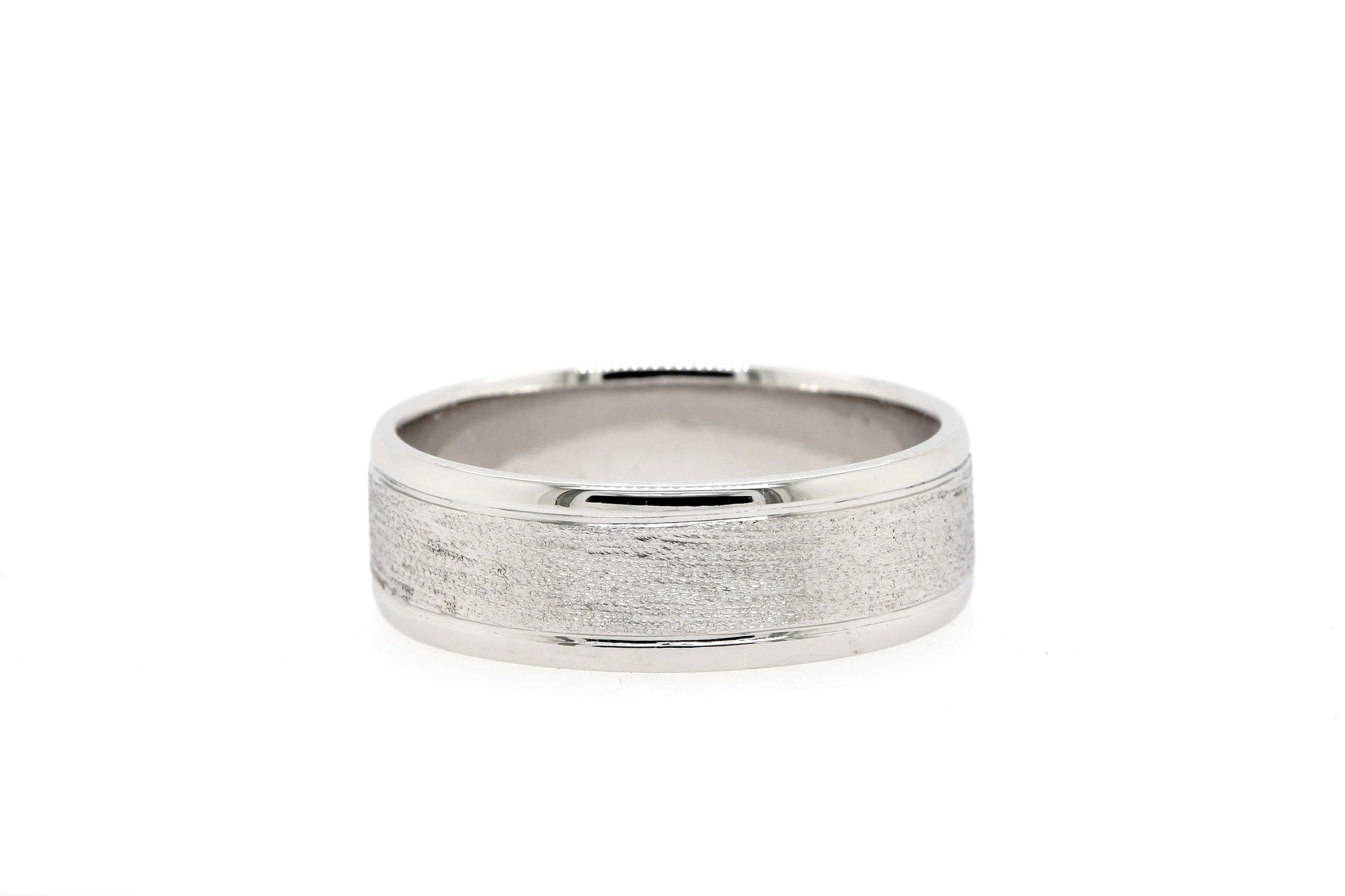
4. Polished Hammered Wedding Ring with Milgrain Edging
While most textured wedding ring designs are (by definition) not polished, it’s possible to include texture yet also have a timelessly polished look. This wedding ring has a surface rippled from hammering, and is finished off with a polished surface. Milgrain edging on each side of the band adds a modern vintage element to the design.

5. Rough Textured Wedding Ring
Textures can be created to be as rough and rugged as you’re willing to wear, especially for pieces that are made by hand. Here, an ultra rough finish is created with hand carved textured patchwork-like segments. Especially when created by hand, a piece like this is entirely unique, with no two textured wedding rings being exactly the same.

To design your very own textured wedding ring, book an appointment directly with the Australian jeweller that handmade each of these textured bands.


3 Mokume Gane Wedding Ring Designs
Mokume Gane is an ancient metal forging technique that creates swirling multi-coloured patterning in a ring. Each one is entirely unique, making it an excellent choice for a wedding ring that no one else will own. Here are 3 unique Mokume Gane wedding ring designs to inspire your very own.
Mokume Gane is an ancient metal forging technique that creates incredible, multi-coloured, swirling patterns. While the Mokume Gane style is recognisable from piece to piece, the nuances of each one is entirely unique. This makes it a wonderful choice for a one of a kind, custom made wedding ring. From the metal colours, to the shape of the band, and the patterns that emerge as the precious metals are worked, every detail comes together to create a design that no one else in the world will own.
Here are 3 Mokume Gane wedding ring designs showing the versatility of this type of ring making, to inspire your own unique piece.
1. Yellow, White and Grey Mokume Gane Ring
Classic yellow gold swirling through this Mokume Gane wedding ring creates a traditional feel to the design, emphasised by the classic low dome profile. A yellow gold sleeve lines the inside of the ring bringing an element of luxury and satisfying heft to the handmade piece.
2. White and Grey Mokume Gane Ring
While multiple colours are needed to create a Mokume Gane design, using metals in the same colour family allows for patterning with contrast, not colour. Light grey (silver) and dark grey (white gold) in this Mokume Gane wedding ring create a distinct pattern with their contrast alone, while remaining an all ‘white’ metal piece. The flatter profile with slightly curved edges creates a modern look, with the comfort of a well shaped band.

3. Rose, White and Grey Mokume Gane Ring
Rose gold is an often overlooked metal choice for wedding rings, and is an excellent metal to include in Mokume Gane designs. Here, its warmth contrasts beautifully with the deep grey and bright white tones of the metals alongside it. A solid rose gold sleeve finishes off the wedding ring beautifully, for a modern, one of a kind, statement wedding ring design.

Design your very own unique Mokume Gane wedding ring with the help of our Canberra based jewellery designer and maker, by booking a time online.


9ct vs 18ct Yellow Gold: What’s the Real Difference Once You’re Wearing It?
When you’re buying a yellow gold wedding ring, you’ll be faced with the choice: 9ct or 18ct? Here’s the real, practical difference when you’re wearing it day to day.
When it comes to yellow gold wedding rings, 9ct and 18ct options may look the same in a jewellery shop, but they behave very differently over time. Here’s the practical difference that actually matters.
The Technical Differences Between 9ct and 18ct Yellow Gold
When you’re buying a yellow gold wedding ring, you’ll be faced with the choice: 9ct or 18ct? There are plenty of technical facts available online to help you decide.
Some differences are are pretty neutral: The colours of the two are visually very similar, and they’re both ‘proper’ precious metals.
Some facts are a personal choice: If your wedding budget is tight, 9ct gold is more affordable than yellow gold.
What 9ct vs 18ct Actually Means When It’s On Your Finger
None of the technical facts, though, capture what the practical difference is once the ring is on your hand. In day-to-day life, the real difference is this: Oxidisation.
To create gold for jewellery, pure gold is mixed with other metals to make up the correct proportions. For 18ct, the proportion of other metals is small, and its effect creates durability in the otherwise malleable gold metal, making it far more suitable to wear as jewellery. For 9ct, the proportion of these other metals is very high, which impacts the oxidisation process. A 9ct gold ring will change colour over time, and more rapidly than most people expect.
Here’s a ring with a 9ct yellow gold brushed centre, part way through a touch up at my jewellery workshop, 2 years into its life. On the left, you can see the deeper, darker oxidised colour it changed to within only 2 years. On the right, is the bright gold colour I restored it to, which is also the original colour of the ring when it was brand new.

Which Yellow Gold Metal Is More Practical Long Term?
Choosing 9ct yellow gold means accepting the ongoing metal colour change, and the ongoing maintenance that requires over time. The original colour can be easily restored, as you can see above. Though the repeated restoration also means it won’t last as long as an equivalent 18ct yellow gold band (see more the lifespan of 9ct and 18ct gold here). A 9ct wedding ring is still a great choice, provided you know what to expect over time.
If your budget allows for it, 18ct yellow gold is the more practical choice long term. It lasts longer, is easier to maintain, and holds its appearance much more consistently in your day to day life. If these factors matter to you, the difference is well worth it.
Still Unsure Which Metal Is Best For Your Own Wedding Ring?
To get personalised advice on your wedding ring metal, or to design your own yellow gold wedding ring directly with an Australian jewellery maker, book an appointment online.
You may also like:
Thinking about a Titanium wedding ring? You must know this first.
If gold or platinum wedding rings aren’t for you, Titanium wedding rings are a great alternative metal. Though you must know this before you put one on your finger.
If a gold or platinum wedding ring isn’t your style, alternative metals are an appealing choice. Titanium wedding rings are an affordable, light and durable alternative - but there’s one thing you should keep in mind if you’re choosing one. Here’s what to know before you buy.
Why Titanium Wedding Rings Are So Popular
Titanium is one of the most popular alternative metals for wedding rings for good reason:
They’re inexpensive. Compared to 18ct gold or platinum, a titanium wedding band costs a fraction of the cost of a precious metal ring. Given the overall costs of a wedding, that difference alone is a huge advantage.
They’re light. Pick one up and you’ll feel the difference immediately. A titanium ring is drastically lighter than a platinum wedding ring. If you’re not used to wearing jewellery, this can make wearing a ring feel less daunting.
They’re strong. Titanium wedding rings are more scratch resistant than precious metals, so they hold up well to everyday wear. They do eventually wear down, and can’t be restored when that happens, unlike their precious metal counterparts. Though the early scratch resistance is appealing initially.
Given these 3 advantages, it’s easy to see why titanium wedding rings have become such a popular option.

Titanium rings like these are a strong, light, affordable alternative to precious metal wedding rings.
The One Thing Most Jewellers Won’t Tell You About Titanium Rings
There’s one more thing most ring sellers won’t mention, and it’s important that you know this before you buy:
If you titanium wedding ring ever starts feeling tight? Take it off straight away.
More often than you’d think, I get calls from people needing engagement rings and wedding rings cut off. It happens. A ring gets a little tight, bit by bit, and suddenly you realise one day you can’t actually take the ring off.
For gold and platinum rings, a ring that gets stuck is an easy fix. You visit a jeweller. Snip. Bend. Ring is off.
It’s not as simple to remove titanium wedding rings. The same properties that make them strong, light and scratch resistant also make them more difficult to be removed. So if you’re about to buy a titanium wedding band, or if you’re already wearing one, remember to take it off if it ever starts getting tight.
For advice on choosing the right titanium wedding ring for your style, and making sure the size is right, book an appointment directly with our jeweller.
You may also like:
A thank you note for a decade of incredible projects, and beautiful stories. Here’s a look back at the decade that was, and the excitement ahead as we celebrate 10 years of Harlequin Jewellers.